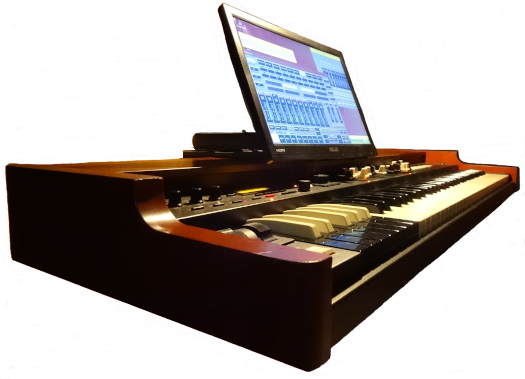
nimbu runs on Windows®. No other system offers such affordable computing power as the PC. If you don't own a PC, a suitable used Mini or Micro PC costs next to nothing nowadays. A used Microsoft® Surface tablet with a touchscreen is ideal and can also be found relatively cheap. It fits perfectly on any music stand (pictured here). Both PCs and tablets can be operated standalone directly at the instrument. nimbu also plays without an internet connection, meaning no security updates are required.
In addition to your PC, all you need is a keyboard instrument with a MIDI output. Existing arranger keyboards are awesome because they usually feature many great voices that you can control directly within nimbu. You can also play nimbu entirely with just a master keyboard. Or on your piano or organ. As a master keyboard, we can recommend the KEYLAB 61 by ARTURIA.
nimbu comes complete with 100 rhythms and 2 integrated synthesizers (sound modules) and is ready to play after a few quick settings. You only need to be somewhat familiar with using a PC and have experience installing other PC programs.
Furthermore, nimbu features a modular design and is equipped with numerous interfaces, allowing you to use high-end audio devices, sound modules, and controllers of your choice. Alternatively, you can run nimbu on modern tablets, or, as shown in the picture above, use a touchscreen connected to your PC.
If you are interested, you should read through the following prerequisites carefully. If you have any questions, simply ask us here.
Your PC
The following 32-bit and 64-bit operating systems are required:
Microsoft® Windows® 7
Microsoft® Windows® 8.1
Microsoft® Windows® 10
Microsoft® Windows® 11
(Microsoft und Windows are Registered Trademarks of Microsoft Corporation.)
The required hardware is a PC, notebook, or tablet with at least:
2 Ghz clock rate or 1.8 Ghz for systems with 2 processor cores
2 GB main memory
2 USB interfaces for MIDI keyboard and nimbu USB license stick or USB hub
MIDI USB interface, if a keyboard or expander with 5-pin DIN MIDI socket is to be used
real-time HD audio device, which is built into most systems today, some even with optical output,
optionally with WDM KS, ASIO®, Direct Sound or WASAPI driver
Screen with minimum horizontal resolution of 1280 pixels.
Optional control directly at the instrument via:
Keyboard keys
Touch Screen
Windows Tablet or Notebook with Touch Screen running nimbu directly
Master Keyboards, MIDI Controller und MID Pads
nimbu features two integrated synthesizers that convert notes into instrument sounds in real time. nimbu lists the suitable audio devices for you, allowing you to select the device driver with the help of a short guide.
Your Sound Module
nimbu comes complete with two software sound modules and a sound library for the instruments (voices). So-called Soundfont® libraries are used, which define an open standard. These libraries are available on the internet in excellent quality at a comparatively low cost, some even for free. Just search for "GM multilayer soundfonts". nimbu plays with the soundfonts or voices you provide.
You can use virtual (VSTi®) instruments by connecting nimbu to your VST® system via a virtual MIDI cable such as loopMIDI. nimbu performs very efficiently. However, an appropriately powerful PC configuration is required to drive the authentic sounds of virtual VSTi® instruments in nimbu.
Basically, nimbu uses the MIDI interfaces that are passed on it by the operating system. So if you are familiar with a MIDI or USB sound module or a MIDI keyboard, you should have no trouble using it as a sound module. nimbu takes over the settings from Cubase® Parser Files or YAMAHA® Voice Lists automatically.
Last but not least a powerful stereo amplifier with good loudspeakers is needed. The sound systems mentioned here produce an expressive sound and excellent surround sound. Both, however, can only be fully exploited with a good amplifier and loudspeaker system.
Your Keyboard
Basically you can play nimbu with any keyboard instrument that features a MIDI OUT interface. A range of 5 octaves and more would be advantageous.
Synthesisers and arranger keyboards with MIDI IN interface can also be used as a sound module. If you already own an instrument or keyboard and are unsure, just ask us.
"SOUNDFONT" ist Registered Trademark der E-MU Systems, Inc., 95067-0015, Scotts Valley, US
"VST" ist Registered Trademarks der Steinberg Media Technologies GmbH, 20097, Hamburg, DE
"Cubase" is Registered Trademark of Steinberg Media Technologies GmbH, 20097, Hamburg, DE
"YAMAHA" is Registered Trademark of YAMAHA CORPORATION, Hamamatsu Shizuoka, JP
ASIO is a registered trademark of Steinberg Media Technologies GmbH
 Playing with YourOwn Instrument